Wednesday, February 18, 2009

If anyone out there actually reads this blog, I must apologize for neglecting it for so long. Since January, I've been reading a 1000-page historical novel about Cleopatra which has been slow going. I have learned some fascinating things about the Egyptian and Roman world of Cleopatra's day, giving me a new appreciation for historical fiction. I hope to finish this book in the next week or so, at which time I'll finish and report on another book I've also started--The Graveyard Book by Neil Gaiman, this year's Newbery award winner. So stay tuned... more to come!

Tuesday, December 30, 2008


Alive and Well in Prague, New York
and Kissing the Bee

I've read two novels over the holidays which, though having pretty different plots, still have enough similarities that I thought I'd just review them together. Both have teenage girls as the main character, and both have other people in their lives which seem to control thier circumstances. In Alive and Well..., Matisse Osgood (named for the famous painter), is the daughter of artistic parents and she grew up in New York City. When her dad's Parkinson's Disease progresses to the point that he can no longer function as he always has, Matisse's parents decide to move to a small town in upstate New York. Matisse is angry and convinced that she can never find anything good about living in a rural town. At the same time, she's dealing with the loss of her beloved father, who has withdrawn into his own world of self-pity. She gradually makes friends and is proven wrong about small town life.

In Kissing the Bee, a darker novel than Alive and Well in Prague, New York, Dana is part of threesome including her best friend Avra and Avra's boyfriend Emil. Dana just happens to be crazy about Emil herself, but would never do anything to hurt Avra, so she just keeps her feelings to herself. It seemed obvious to me that Dana and Avra are polar opposites. Dana is thoughtful, selfless. level-headed, and goal-oriented. Avra is a self-centered, abusive, druggie who thinks about nothing but escaping her family and her life. This story is told in context with Dana's science project about honey bee communities, and Avra is definitely the queen bee of her world. Dana finally reaches her limit with Avra and ends the friendship, not a moment too soon, in my opinion. Even then, Avra doesn't betray even a second of sorrow or regret, ever thinking only of herself.

Both stories end on happy notes with satisfying resolutions to those controlling
factors in the lives of their main characters, Matisse and Dana. Quick reads
with appealing characters.
--reviewed by Mrs. Sams


Tuesday, December 16, 2008

Looking for salvation at the Dairy Queen
by Susan Gregg Gilmore
Now this is my kind of book. Narrated by Catharine Grace, this is a sweet story of a Georgia preacher and his two motherless daughters, in a small town filled with two-named people (Martha Ann, Lena Mae, Emma Sue, Gloria Jean, Ida Belle...) who have just enough meanness and weaknesses mixed in with their goodness to make the story realistic. Catharine Grace has never wanted anything more than getting out of her one-horse town the minute she turned 18, and that's exactly what she did. When she got her own room in Miss Mabie and Flora's house, and a job at the Davison's department store in Atlanta, she felt she was on her way to getting everything she ever wanted. It was harder on her Daddy and her sister than Catharine Grace that she couldn't come home for Thanksgiving or Christmas. But when the telegram came on Jan. 3 saying that her Daddy had died, she knew she had broken his heart and been the cause of his death.
When Catharine Grace got home for the funeral , she came face to face with enough shocking situations, that she wasn't sure she could ever have loving thoughts of her Daddy again, but after a good talk with Eddie Franklin at the Dairy Queen, she realizes that nobody is perfect in this life, and it seems like she just had to get away from home for awhile to realize there was nowhere else she'd rather be. Looking for Salvation at the Dairy Queen is a great get-away-from-it-all novel with a funny and touching message.
--reviewed by Dail Sams

Monday, December 15, 2008


things that are
by Andrew Clements
The third in the "invisible" series, this installment focuses on the creepy, invisible character William, introduced in Things Hoped For. Alicia, who is blind, is struggling to keep her head straight about her friend Bobby, for whom she has developed more than friendship feelings. Bobby is returning in a couple of days from New York City where he has been doing auditions for music scholarships. While working at the library, Alicia is approached by William who tells her that Bobby is being followed by two men and could be in trouble. Alicia figures out pretty easily that William is invisible and naked, and she doesn't trust him at all. But she's afraid for Bobby, so she can't disregard what William says altogether. When she reaches home, FBI agents come to the door, and suddenly William's story becomes more plausible. Everyone in both Bobby and Alicia's families knows that the whole invisibility thing must be kept from the government, or their lives will never be their own again. When William comes to Alicia's back door freezing, and she lets him in, it becomes obvious to both her and Bobby, that they must do something for him, regardless of the FBI. This is a satisfying continuation of the story begun in Things Not Seen, as Alicia realizes that she can only live as honestly as she can in the here and now, because that's all that's real.
--reviewed by Dail Sams

Tuesday, December 09, 2008


Princess Ben

by Catherine Gilbert Murdock


This third novel by Murdock is a departure from her first two modern day works for young adults. Princess Ben is more of a fairy tale complete with magic mirrors, a flying broom, and somewhat wicked queen. Ben, short for Benevolent, is a princess of a imaginary mountainous kingdom. Since her father is brother to the king, and her mother dislikes the confinement of life at court, Ben has been allowed to grow up with a great deal of freedom--she plays with village children, she wears what she wants, runs where she will, and most of all, eats as much as she wants. Consequently, Ben is rather pudgy. Ben's carefree life comes to a crashing halt when the king and both her parents are murdered while on a short ceremonial journey. The queen takes Ben in hand, forces her to live in the palace, wear beautiful but uncomfortable clothes, take dancing lessons, and eat very little. She is being prepared to become the ruler of her small country and the bride of the prince of a stronger neighboring kingdom. When Ben rebels, the queen moves her into a tower room connected to the queen's own chambers. She is locked in at night and watched every minute of the day. But Ben soon discovers that her cold tower room connects to a magic room. There she learns a number of helpful spells which get her into more trouble than she bargained for. But, this is a fairy tale, and eventually, Ben lives happily ever after! This is a fun read with witty allusions to a number of familiar fairy tales.
Reviewed by Mrs. Sams

Monday, December 01, 2008


Thirteen Reasons Why

I had a student come into the library the other day looking for depressing books. He said he could get into the characters more easily when the story was depressing. That being the case, he shouldn't have too much trouble finding a book to read, because at least half of all young adult novels are depressing, imho. I just finished a really good and depressing novel--Thirteen Reasons Why by Jay Asher. Hannah Baker makes 13 audio tapes for thirteen classmates who contributed to her decision to commit suicide. After her death, her tapes start circulating among the people for whom she blames her misery. We readers get to listen to her narration with Clay, the one student she doesn't blame for anything. It doesn't really matter, because after listening to the tapes, Clay blames himself for his insensitivity, and especially, for his fear of talking to Hannah and of trying to help her. There's nothing Clay can do to change the situation, because Hannah is already dead by the time he listens to her tapes. But he realizes he can change himself.

This is definitely a depressing book, and an insightful look into the heart and mind of a suicidal teen. But I did find myself getting angry at Hannah sometimes as the story progressed, because she made some bad choices which contributed to her misery. She couldn't legitimately blame all her problems on other people. However, it was obvious that Hannah, and perhaps most teens who think about killing themselves, lose the ability to see themselves and their situation for what it really is, and so they can't find the hope to hang on. Thirteen Reasons Why is a sad and gripping tale of high school at its worst, and a girl who grew too tired to wait for better times.

Reviewed by Dail Sams

Thursday, November 20, 2008


The Patron Saint of Butterflies

by Cecilia Galante

Honey and Agnes have lived their whole lives in a religious commune in Connecticut. Their leader Emmanuel is revered by all and feared by most. The two girls have been called to the "Regulation Room" on several occasions, most recently because Honey was caught kissing a boy, and Agnes was considered an accomplice. Both girls come out with red welts all over their backs and legs. All the adults in the commune just look the other way when these situations arise. Agnes always blames herself and believes Emmanuel knows what's best for the "Believers." Honey just gets angrier and more determined to escape the commune. When Agnes's grandmother arrives for an unexpected visit, and learns about the Regulation Room, she decides it's time to take the children away from the commune. However, when Agnes's little brother Benny is severely injured by a heavy, carved wooden door closing on his hand, Nana Pete realizes that time has run out. Emmanual has done a butchered job of sewing Benny's fingers back on, then declaring it a miracle, but it is obvious Benny will die if he doesn't get competent medical attention immediately. Against Agnes's better judgment, she, Honey and Benny leave the commune with Nana Pete to seek medical attention for Benny. This is the first time any of the children have ever been away from the commune, and they are faced with an unimagined new life. Each new experience is a fun adventure for Honey; each one an evil temptation for Agnes. Both are faced with difficult decisions and come to unexpected conclusions. The Patron Saint of Butterflies is a timely coming of age story. Reviewed by Dail Sams

Friday, November 14, 2008


Since school started, it's been tough to find time to read and add to this blog. However, I recently finished Black Rabbit Summer by Kevin Brooks. I had this book on a future order, but decided I ought to read it first. It is a typically tense and suspenseful Brooks novel, so I have no doubt it would appeal to a lot of guys. However, the story is a little raw for me--I'm choosing not to add it to the high school collection. The story, which centers around the reunion at a carnival of some high school friends who had drifted apart, has too much of too many things. The tone of the novel is very dark and melancholy. When one of their old classmates turns up dead after the carnival, and another one missing, doubt, suspicion, and mistrust consumes Pete, the main character of the book. Since the missing classmate is Pete's best friend, his investigation into the murder parallels the police investigation. Although the murder is solved by the end of the book, Brooks leaves many unanswered questions, which could frustrate some readers. In spite of the negative aspects of this book, Black Rabbit Summer is not without redeeming qualities. Even with his faults, I had to like Pete for his loyalty to his friend Raymond, who was quite a strange character. And I really liked that Pete's parents were good people and that Pete obviously loved and respected them, even if he didn't always obey them. But bottom line, there are plenty of good, suspenseful mystery stories out there without all the language and questionable activities. Black Rabbit Summer is on next year's Tayshas list, so there are lots of librarians out there who like this book. It has received excellent reviews. But I think I'll let any student who wants to read this book find it at the public library.
--Reviewed by D. Sams


Monday, September 15, 2008


the dead & the gone

by Susan Beth Pfeffer


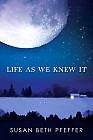
Life for Alex Morales, a New York City Puerto Rican teenager, changed forever without a second of warning. An asteroid collides with the moon, moving it closer to the earth. As a result, the moon's gravitational pull adversely affects the tides, causing worldwide flooding of low-lying areas. It also causes an increase in volcanic activity, so that the air becomes filled with ash, blocking out the sun's rays. Within months, New York City is constantly freezing, breathing is difficult, and nothing will grow. Alex's father was in Puerto Rico for his mother's funeral when the asteroid hit, and his mother was called in to the hospital to work. Neither one ever comes home, and 17-year-old Alex is left to care for his two younger sisters alone with food more and more difficult to come by. Alex is forced to take extreme actions just to survive. This is an unrelentingly bleak look at one possible future on an earth with severe climate changes. I wanted to quit reading, on every page because it was so depressing, but I just couldn't. This book is filled with small kindnesses and unselfish acts on the part of several characters, in spite of their need to survive, and I just had to know what happens to everyone. The Dead and the Gone is a companion book to Life as We Knew It, the same story told from the viewpoint of a small-town teenaged girl. Both books are thought-provoking reads with characters worth caring about, and very timely themes in light of the current global climate change debate.
--Reviewed by Mrs. Sams

The Invention of Hugo Cabret
by Brian Selznick
Do you remember those picture books from your elementary days that had the great pictures? Books like Make Way for Ducklings by Robert Mccloskey, Owl Moon by Jane Yolen, Smoky Night by Eve Bunting, and The Polar Express by Christ Van Allsburg? All of these were Caldecott Award winners and written for young elementary students. The Caldecott award is a prestigious award given annually to children's book illustrators. This year, for the first time in recent memory, the Caldecott went to the writer of a book written for older students. The Invention of Hugo Cabret is a thick book (533 pages) with dozens of lovely and intricate black and white pencil drawings. It's part picture book, part graphic novel, part motion picture. I loved this book for its artwork as much as anything, but it also has an interesting and creative storyline loosely based on the life of one of the earliest French moviemakers. I would recommend this book to anyone--it's not only a good read, but it's also a visual feast. Most students could read this book in a couple of hours, but you just have to take a little time to enjoy the art.
--Reviewed by Mrs. Sams